

Interpreting and Enriching Occupational Contexts
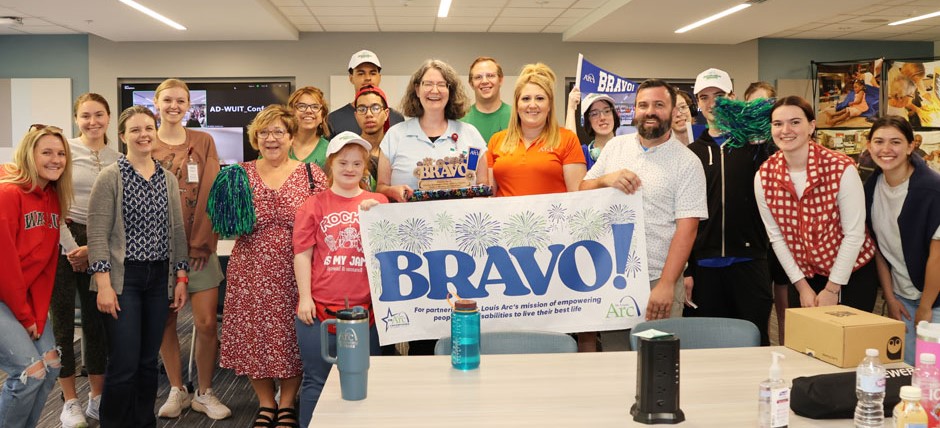
Dr. Mahoney has 2 lines of scholarly research: enhancing the lives of people with developmental disabilities and studying occupational therapy history. Her work focuses on occupational contexts, the factors outside a person or group that affect participation, including social support, physical environments, policy, social determinants of health, and historical contexts. Her historical research involves interpreting occupational contexts by exploring issues in occupational therapy, who was involved, and how the issues developed and changed over time. Her current work with people with developmental disabilities involves enriching occupational contexts by working with the St. Louis Arc Next department to enhance their transition to adulthood programs.
Dr. Mahoney mentors students in community-engaged research in collaboration with young adults with developmental disabilities, staff, and families. The research focuses on enhancing and enriching programs at St. Louis Arc that support youth and young adults as they build skills and resources to transition from adolescence to adult life. Current projects prioritize young adults with developmental disabilities as equal partners in the research process to ensure transition programs meet their needs for a successful and satisfying adult life.
General Description of Student Activities
Students working with Dr. Mahoney and her team will
- Develop a range of research skills: Engage with qualitative, quantitative, and/or mixed methods, and gain hands-on experience in participatory action research (PAR), one of the most effective ways to engage in research as part of OT practice.
- Build skills for collaboration: Partner with young adults with developmental disabilities as well as staff and agency leaders in a community-centered research approach.
- Translate knowledge and research into real program change: See your work and existing research implemented in real-life settings and contribute to programs that make a meaningful difference.
- Contribute to publications and/or presentations: Opportunities to participate in activities that lead to publications and presentations with variable levels of involvement and options available.
- Cultivate versatile skills in research and project management: Gain experience in literature review, research design, data collection, and analysis, as well as public engagement and communication.
Students will volunteer with in-person and online transition program activities to understand the perspectives, strengths, and needs of young adults with developmental disabilities, staff, and the program. Students will review relevant literature, provide input on designing the research study, and collect and analyze data in collaboration with the transition program team. Students will participate in the action research process to develop and implement solutions that lead to continuous program enhancement.
Examples of Projects
- Enhancing self-determination opportunities with young adults with developmental disabilities
- Evaluating the collaboration process between St. Louis Arc and WashU OT
- Training young adults with developmental disabilities to become co-researchers and exploring their perspectives on the research process
- Enhancing transition program activities to facilitate making and maintaining friendships
Faculty
Wanda Mahoney, PhD, OTR/L, FAOTA
Professor of Occupational Therapy and Medicine