

Navigating Long COVID
Michelle Furman, MOT, OTR/L, helps clients navigate life with long COVID
by Michele Berhorst • April 29, 2025
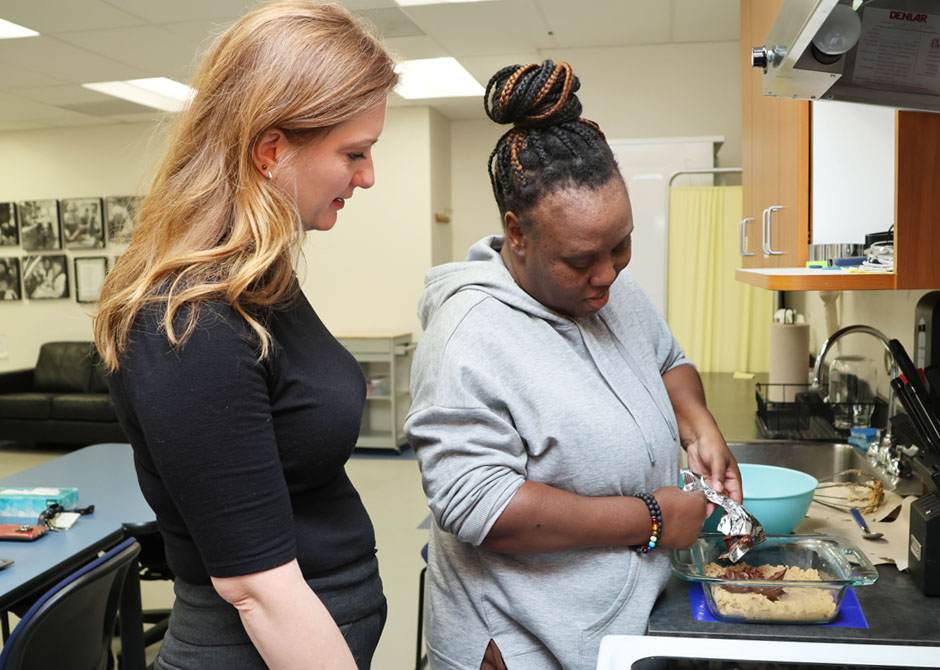
Furman (left) observes as Darnisha Simms prepares a dessert, working toward her goal to resume cooking for herself at home.
“I’m not sure we had the term ‘long COVID’ yet. I recall it was all hands on deck once we returned to full operations in 2020 and started receiving physician referrals for patients with symptoms such as fatigue, brain fog, sleep disturbances and anxiety,” remembered Michelle Furman, MOT, OTR/L, an occupational therapist with WashU Medicine’s Occupational Therapy (OT) Services.
The U.S. National Academies of Sciences, Engineering and Medicine defines long COVID as “a medical condition that persists for at least three months after an infection with SARS-CoV-2, the coronavirus that causes COVID-19.” It can affect any organ or system in the body, and people may have any of more than 200 symptoms. Currently, there is no cure.
“People with long COVID have had their entire lives upended. They may have been an otherwise healthy individual and now have a chronic condition that is interfering with their ability to resume their daily activities and occupations,” Furman said. “As occupational therapists, we understand that what people do creates their identities. There can be a great sense of loss for people with long COVID — they are not doing the things that make them feel like themselves.”
OT interventions
WashU Medicine established the Care and Recovery After COVID-19 (CARE) Clinic, a multidisciplinary clinic to evaluate patients who have continued symptoms or complications after a confirmed COVID-19 illness. The CARE Clinic’s medical team — Gayathri Krishnan, MD, and Sarah Alleman, NP-C — refer patients to Furman and her colleagues to develop individualized treatment plans to address people’s health-care goals.
Furman, who specializes in neurorehabilitation, often starts by looking at the interactions between the different symptoms a client might be experiencing. “Fatigue, anxiety, lack of sleep and brain fog can impact and trigger each other. Clients may feel trapped in this cycle where they feel they have no control over their symptoms. They become increasingly frustrated,” Furman explained. “I help clients disrupt this cycle and find ways to resume their life roles such as parenting, working and caregiving with modifications.”
OT interventions can include activity planning, sleep hygiene, implementing strategies for energy conservation, relaxation, stress management, reducing mental fatigue, practicing mindfulness, and keeping track of cognitive concerns between visits.
“A way to describe what happens in the brain is the neurological threshold has changed with long COVID. An example of a before-and-after symptom would be if it took someone being out all night at a concert, in a crowd, standing next to strobe lights and speakers to feel a certain level of fatigue and exhaustion,” Furman said. “Now, that person would get to that same fatigue level by cooking dinner after work with the TV on and their kids home moving about. An OT intervention could be creating a routine for weekly meal planning to decrease the daily cognitive load, prepping some of the meals ahead of time for fatigue management, and wearing earplugs to dampen the noise.”
For clients in work settings, Furman helps them with training, education and self-advocacy. “We can help them identify and establish effective work accommodations. People can have great functional improvements with lifestyle modifications and compensatory strategies.” Strengths and barriers to optimal work performance are identified through occupational analysis. Occupational therapists may do work simulations to practice using different strategies or equipment or may recommend alternate routines or schedules for work. Occupational therapists can also assist clients in navigating communication about formal work accommodations with their human resources department.
Furman finds that the key is helping clients shift their mindset and expectations. “People are used to receiving an acute diagnosis and a quick fix, but this isn’t the case with long COVID. This is a chronic condition and something they may have to live with for the rest of their lives. It’s adjusting behavior to accommodate new capacities and focusing on feeling as good as possible. It’s finding the balance of meaningful participation and symptom management.”
Shared medical appointments
Furman is part of a new short-term supportive program spearheaded by the WashU Living Well Center to provide lifestyle medicine interventions for patients diagnosed with long COVID in the CARE clinic called shared medical appointments (SMAs). The SMA program was developed from a five-year grant totaling $4.5 million from the U.S. Department of Health and Human Services, through the Agency for Healthcare Research and Quality. Abby L. Cheng, MD, a WashU Medicine physical medicine and rehabilitation physician, is the lead principal investigator on the grant.
“The grant was part of a federal initiative to urgently improve care coordination, to facilitate equitable access to medical and social resources and support primary care teams in addressing needs related to long COVID, particularly for the underserved. Different models of care were considered, but to reach the greatest number of patients with the most services efficiently and cost-effectively, the SMA program was decided upon,” Furman said. “An SMA session is six weekly, one-hour classes that patients can attend virtually or in person. Missouri and Illinois Medicaid cover the sessions.”
“Each class begins with a check-in with the medical provider — Sarah Alleman. Then, we have divided the six weeks into two-week visits each for OT, physical therapy (PT) and speech-language pathology (SLP) so the therapists can introduce content and provide additional resources and information,” Furman shared. “We work together to plan our content and make sure we are complementing one another. OT sessions may address fatigue and energy conservation for daily living and functional cognition; PT sessions may address physical activity, exercise and pacing; and SLP therapy may address communication, cognitive skills and strategies.”
Whether she sees clients in either setting, Furman finds meaning in validating her patients’ diagnoses and helping them adjust to life with long COVID. “The best outcome is when a client comes to the point where they have accepted the changes in their life. It doesn’t happen spontaneously; it happens through time, by being validated and building awareness about what is different in their mind and body and how they can adjust their behaviors and habits successfully.”